
Intro B Dressage Test: A Comprehensive Guide
This guide delves into the Intro B dressage test, offering a foundational competition for both horse and rider, often found as a PDF download.
Diagrams are crucial for understanding movements like circles and serpentines, solidifying basic gaits and transitions for aspiring dressage competitors.
What is the Intro B Dressage Test?
The Intro B Dressage Test represents a crucial first step into the disciplined world of dressage competition. It’s specifically designed as an introductory level, welcoming novice horse and rider combinations eager to demonstrate fundamental skills. Often available as a PDF for convenient access, this test focuses on establishing a solid foundation in basic horsemanship and correct dressage principles.
This initial level isn’t about complex maneuvers; instead, it emphasizes the horse’s willingness to respond to the rider’s aids, showcasing a basic understanding of gaits – walk and trot – and smooth, balanced transitions between them. Riders will encounter movements like a free walk, medium walk, working trot, and a 20-meter circle at working trot.
Many resources, including downloadable diagrams, are available to help visualize the arena layout and movement patterns. These visual aids are incredibly helpful for both preparation and execution. The Intro B test serves as a building block, preparing horse and rider for the challenges and intricacies of higher-level dressage tests.
Purpose and Level
The primary purpose of the Intro B Dressage Test is to introduce both horse and rider to the competitive dressage arena, confirming the development of correct basic principles. It’s a stepping stone, designed to assess whether the partnership is beginning to understand and execute fundamental movements with accuracy and harmony. Frequently found as a downloadable PDF, the test provides a standardized framework for evaluation.
As an introductory level, Intro B doesn’t demand advanced skills. Instead, it focuses on showcasing a horse’s willingness to accept the rider’s aids and demonstrate basic gaits – walk, trot – with balance and rhythm. Riders will be evaluated on their ability to perform simple transitions and maintain a consistent tempo.
Diagrams accompanying the test, often included in the PDF, are essential for understanding the arena layout and movement patterns. This level is a significant milestone, marking the beginning of a competitive pathway, and solidifying the foundation for future dressage endeavors.
Arena Dimensions and Markings
The Intro B Dressage Test is traditionally conducted within a 20-meter by 40-meter arena. Accurate arena dimensions and precise markings are crucial for fair and consistent evaluation, often detailed within the PDF test guidelines. These dimensions provide sufficient space for the required movements, including circles, serpentines, and straight-line work.
Key markings include a centerline dividing the arena lengthwise, quarterlines at 1/4 and 3/4 points along the long sides, and markers indicating the 20-meter circle points. These markers serve as visual guides for both horse and rider, ensuring accuracy in performing the test’s elements. Diagrams within the PDF frequently illustrate these markings clearly.
Properly establishing these markings is essential, as deviations can impact a horse’s balance and the overall impression of the test. Riders should familiarize themselves with the arena layout before competing, utilizing the PDF’s diagrams to visualize the test flow and movement placement.

Test Overview & Movements
The Intro B test, often available as a PDF, assesses foundational skills through movements like free walk, working trot, and 20-meter circles.
Diagrams aid understanding.
Core Skills Assessed
The Intro B dressage test, frequently accessed as a PDF guide, fundamentally evaluates a horse and rider’s basic competency and harmonious partnership. Diagrams within these guides visually clarify expected performance. Core skills center around demonstrating correct gaits – walk and trot – and seamless transitions between them.
Judges assess the horse’s obedience, responsiveness to aids, and overall balance. The rider’s position, effectiveness of aids, and ability to clearly communicate intentions are also key components. Emphasis is placed on establishing a relaxed and willing attitude in the horse, showcasing the beginnings of proper dressage training.
The test isn’t about complex maneuvers, but rather about showcasing a solid foundation. Correctness of form, rhythm, and suppleness are prioritized. A PDF version often includes scoring sheets, highlighting areas of focus for evaluation, allowing riders to understand where improvements can be made. Ultimately, the Intro B aims to confirm a basic understanding of dressage principles.
Walk Movements
Walk movements within the Intro B dressage test, often detailed in PDF test guides with helpful diagrams, are crucial for assessing the horse’s relaxation and basic rhythm. The test typically includes both a free walk and a medium walk. The free walk demonstrates the horse’s ability to move freely and willingly forward, showcasing relaxation and covering ground efficiently.
The medium walk requires a slightly more energetic and engaged pace, still maintaining a clear four-beat rhythm. Riders must demonstrate control and consistency in both gaits. Diagrams in the PDF often illustrate the expected track and positioning for these movements. Judges evaluate the horse’s regularity, straightness, and the rider’s ability to maintain a consistent contact.
These walk sections serve as a foundation for more challenging gaits, highlighting the importance of establishing a calm and obedient horse. A successful walk demonstrates the beginning of a harmonious partnership and correct dressage basics.
Free Walk
The free walk segment of the Intro B dressage test, clearly outlined in available PDF guides and often accompanied by illustrative diagrams, is a foundational element. It assesses the horse’s natural rhythm, relaxation, and willingness to move forward freely. Riders are expected to present a loose rein, allowing the horse to stretch and cover ground in a relaxed manner.
Judges evaluate the horse’s regularity of the four-beat rhythm, its straightness, and the overall impression of ease and comfort. The diagrams within the PDF resources typically show the expected track – often a straight line or a gentle curve – and the appropriate positioning of the horse and rider. A truly successful free walk demonstrates a horse that is supple, balanced, and responsive to minimal aids.
This movement isn’t about collection or impulsion, but rather about showcasing the horse’s natural gaits and establishing a relaxed connection between horse and rider. It’s a crucial building block for more advanced dressage work.
Medium Walk
The medium walk, detailed in Intro B dressage test PDF resources and often visualized with helpful diagrams, requires a noticeably more active and energetic walk than the free walk. While maintaining a clear four-beat rhythm, the horse should demonstrate increased covering of ground and a more engaged hind leg. Riders should exhibit a light but clear contact, encouraging forwardness without tension.
Judges assess the horse’s regularity, activity, and the rider’s ability to maintain a consistent tempo. Diagrams in the PDF guides illustrate the expected track – typically a straight line – and the appropriate length of stride. The medium walk isn’t about speed, but about increased impulsion and covering ground efficiently.
A successful medium walk showcases a horse that is responsive to the rider’s aids, maintaining a balanced and purposeful stride. It’s a key transition movement, preparing the horse for more collected work and demonstrating the rider’s control over the horse’s energy.
Trot Movements
Trot movements form a significant portion of the Intro B dressage test, as detailed in available PDF guides and illustrated with helpful diagrams. These movements assess the horse’s ability to maintain a consistent two-beat rhythm and the rider’s effectiveness in controlling tempo and straightness. Riders will encounter both working trot and a 20-meter circle at working trot.
The PDF resources emphasize the importance of a clear and active trot, with the horse demonstrating engagement of the hindquarters. Diagrams often depict correct positioning and track lines, aiding riders in visualizing the expected performance. Judges evaluate the horse’s regularity, suppleness, and the rider’s ability to maintain a consistent contact.
Mastering these trot movements is crucial for success at Intro B, as they lay the foundation for more advanced dressage work. Proper preparation and understanding of the test requirements, aided by diagrams, are key to a harmonious and accurate performance.
Working Trot
Working trot, a core element of the Intro B dressage test, requires the horse to exhibit a clear, active, and rhythmic two-beat gait. PDF guides and accompanying diagrams illustrate the expected quality – a forward-thinking horse covering ground with impulsion. Riders must demonstrate control without restricting the horse’s natural movement.
The diagrams often highlight correct rider posture and rein contact, emphasizing a balanced seat and soft hands. Judges assess the horse’s regularity, suppleness, and the rider’s ability to maintain a consistent tempo. A successful working trot showcases engagement of the hindquarters and a clear acceptance of the bit.
PDF resources emphasize that the working trot isn’t simply a faster trot; it’s a quality of movement. Riders should focus on maintaining straightness and avoiding rushing or dragging. Mastering this foundational gait, with the aid of visual diagrams, is vital for progressing in dressage.
20-Meter Circle at Working Trot
The 20-meter circle at working trot, a key component of the Intro B dressage test, assesses the horse’s balance, suppleness, and responsiveness to the rider’s aids. PDF test guides frequently include diagrams illustrating the precise dimensions and expected shape of the circle – a true circle, not an oval.
These diagrams demonstrate the rider’s position, maintaining equal distance from the center throughout the circle. Judges evaluate the horse’s ability to maintain a consistent rhythm and bend, with the inside hind leg tracking accurately. The rider must demonstrate control without forcing the bend or losing impulsion.
PDF resources emphasize the importance of a clear, visible bend and a consistent tempo. Riders should use their inside leg to encourage bend, their outside rein to contain the shoulder, and maintain a balanced seat. Mastering this movement, aided by visual diagrams, is crucial for demonstrating basic dressage principles;
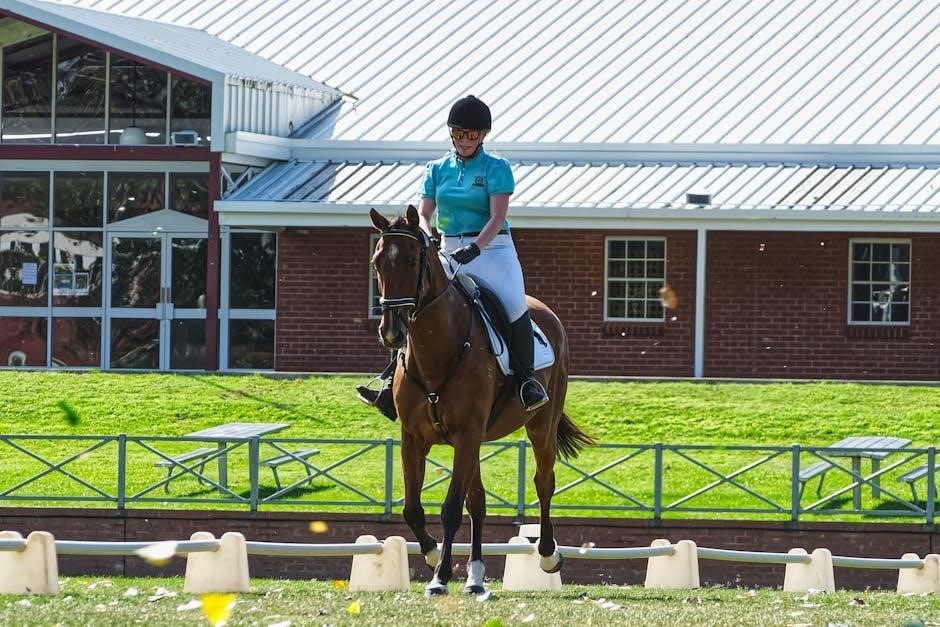
Scoring and Evaluation

Scoring in the Intro B dressage test, often detailed in PDF score sheets and guides, focuses on accuracy, rhythm, and submission. Diagrams aid understanding.
Judging Criteria
Judges evaluating the Intro B dressage test, often referencing diagrams within the PDF test guidelines, prioritize a holistic assessment of the horse and rider partnership. The core focus lies on demonstrating correct dressage basics, including the quality of gaits – walk and trot – and the smoothness of transitions between them.

Accuracy is paramount; judges meticulously observe the horse’s adherence to the arena’s boundaries and the precise execution of movements like circles and serpentines. Rhythm and regularity are also key, ensuring a consistent tempo throughout the test. Submission, reflecting the horse’s willingness to accept the rider’s aids, is carefully assessed.
The rider’s position, seat, and use of aids are scrutinized to determine their effectiveness and harmony with the horse. A clear and consistent application of aids, without excessive force, is highly valued. Judges also consider the overall impression of the test, looking for a harmonious and willing partnership that showcases the horse’s potential. The PDF resources often detail specific percentage breakdowns for each element, providing clarity on scoring priorities.
Common Mistakes and Penalties
Riders attempting the Intro B dressage test, guided by diagrams in the PDF test materials, frequently encounter common errors. These include inaccurate circles, often drifting off the intended 20-meter diameter, and uneven serpentines. Tension in the horse, stemming from rider anxiety or incorrect aids, is a frequent penalty point.
Poor transitions – rushed, unbalanced, or lacking clarity – are heavily marked down. Failure to maintain a consistent rhythm and tempo throughout the test also incurs penalties. Riders may lose points for incorrect rein handling, such as pulling or sawing at the mouth, or for a consistently incorrect seat position.
Hesitation, refusal, or resistance from the horse, indicating a lack of submission, results in significant deductions. Ignoring the centerline or track lines, and failing to halt squarely, are also common mistakes. The PDF test guidelines clearly outline the penalty scale for each infraction, allowing riders to anticipate and avoid these errors during preparation and competition.
Understanding the Score Sheet
The Intro B dressage test score sheet, often accompanying the PDF test and diagrams, is a crucial tool for both rider and trainer. It’s divided into sections evaluating each movement, with scores ranging from 0 to 10, reflecting quality and correctness. A higher score indicates superior performance.
Each movement is assessed based on criteria like accuracy, rhythm, suppleness, and the horse’s obedience to the aids. Judges provide comments alongside the numerical scores, offering specific feedback on areas for improvement. Understanding these comments is vital for targeted training.
The score sheet also includes coefficients, weighting certain movements more heavily than others. Penalties for errors, such as incorrect transitions or deviations from the required figures, are deducted from the base score. Familiarizing yourself with the scoring system, as detailed in the PDF, allows riders to prioritize training efforts and maximize their potential score.

Preparing for the Intro B Test
Thorough preparation, utilizing Intro B dressage test PDFs and diagrams, is key. Focus on solidifying basic gaits, transitions, and rider position for success.
Horse Training and Conditioning
Effective preparation for the Intro B dressage test necessitates a well-conditioned horse, capable of performing the required movements with comfort and accuracy. Begin with a solid foundation of flatwork, focusing on establishing consistent, balanced gaits – walk, trot, and halt – as outlined in Intro B dressage test PDFs.
Regular, progressive training is crucial. Incorporate exercises that improve suppleness, responsiveness to aids, and straightness. Utilize diagrams to visualize correct track and bend on circles and serpentines. Pay close attention to transitions, ensuring they are smooth and prompt.
Conditioning should include both groundwork and ridden work. Build stamina gradually, incorporating hill work and varied terrain. Ensure the horse is physically fit enough to maintain the required level of performance throughout the test. Addressing any physical limitations or asymmetries is vital before increasing the workload. Remember, a comfortable and confident horse will perform better and be less prone to errors.
Rider Preparation
Successful execution of the Intro B dressage test demands a rider who is both knowledgeable and proficient in the fundamentals of dressage. Thoroughly study the test requirements, utilizing diagrams from Intro B dressage test PDFs to visualize the arena layout and movement patterns.
Practice riding the test repeatedly, focusing on accuracy, timing, and clear communication with your horse. Develop a secure and effective seat, maintaining balance and independence of aids. Work on refining your transitions, ensuring they are smooth, prompt, and balanced.
Mental preparation is equally important. Visualize a successful ride, focusing on positive outcomes. Develop a pre-ride routine to calm your nerves and enhance focus. Understanding the judging criteria, as detailed in official dressage resources, will help you prioritize key elements and present your test confidently.
Test Riding Strategies
Approaching the Intro B dressage test requires a strategic mindset. Before entering the arena, review the test, visualizing each movement and transition – utilize diagrams from Intro B dressage test PDFs for clarity. Plan your track to maximize efficiency and demonstrate a harmonious partnership with your horse.
During the ride, maintain a consistent tempo and rhythm. Focus on clear and subtle aids, avoiding excessive corrections. Ride each movement with intention, striving for accuracy and balance. Remember to breathe and maintain a relaxed posture, which will positively influence your horse.
Prioritize the core skills assessed – walk, trot, and transitions. A smooth, consistent walk and a balanced, rhythmic trot are fundamental. If a mistake occurs, don’t dwell on it; simply refocus and continue with the test. A positive attitude and a harmonious connection with your horse are key to a successful performance.
Resources and Further Information
Explore USDF and USEF rules for detailed guidelines. Download Intro B dressage test PDFs and utilize available diagrams for visual learning and improved understanding.
USDF and USEF Rules
Understanding the rules set forth by the United States Dressage Federation (USDF) and the United States Equestrian Federation (USEF) is paramount for anyone participating in the Intro B dressage test. These organizations govern the sport, ensuring fair competition and standardized practices across the country.
The USDF provides detailed information regarding test requirements, scoring guidelines, and eligibility criteria. Their rulebooks, often available for download on their website, outline specific expectations for both horse and rider at the Intro B level. These resources are invaluable when preparing for a competition, as they clarify acceptable movements and potential penalties.
USEF rules complement those of the USDF, focusing on broader equestrian regulations and competition licensing. Familiarizing yourself with USEF membership requirements and show protocols is essential for legal participation. Both organizations frequently update their rules, so staying current is crucial.
Accessing these rules, often in PDF format, allows riders to study the intricacies of the Intro B dressage test and ensure compliance. Many diagrams illustrating correct arena setup and movement patterns can also be found within these official publications, aiding in visualization and preparation.
Intro B Dressage Test PDF Downloads
Locating official Intro B dressage test PDF downloads is a crucial step in preparation. The USDF (United States Dressage Federation) website is the primary source for these documents, offering the most up-to-date and accurate test information. These PDFs typically include the test diagram, movement descriptions, and scoring guidelines.
Several websites compile links to these official downloads, streamlining the search process. Look for resources that specifically mention USDF or USEF (United States Equestrian Federation) as the source to ensure authenticity. Beware of unofficial sources that may contain outdated or inaccurate information.
The PDF often contains detailed diagrams illustrating the arena layout, correct track lines, and the placement of letters. These visual aids are invaluable for understanding the test’s flow and planning your ride.
Downloading and printing the Intro B dressage test PDF allows for convenient study and annotation. Riders often mark key points, transitions, and potential challenges to refine their performance. Having a physical copy readily available during training and at the show ring is highly recommended.
Diagrams and Visual Aids
Visual aids, particularly arena diagrams, are indispensable when learning the Intro B dressage test. These diagrams, commonly found within the official PDF test documents, clearly illustrate the 20×40 meter arena layout, letter placements (A, B, C, E, K, M), and the intended track lines for each movement.
Understanding the diagrams helps riders visualize the test’s flow and accurately position themselves and their horse. They are crucial for movements like the 20-meter circle at working trot and the serpentines, ensuring correct geometry and balance. Many online resources offer supplementary diagrams and videos demonstrating the test.
Beyond the basic arena layout, some diagrams depict specific movement patterns, highlighting the precise path a horse should follow. These detailed visuals aid in memorization and improve accuracy during competition.
Utilizing these diagrams during training allows riders to practice the test with confidence, knowing they are following the correct course. Combining diagrams with video analysis of successful rides further enhances learning and performance.